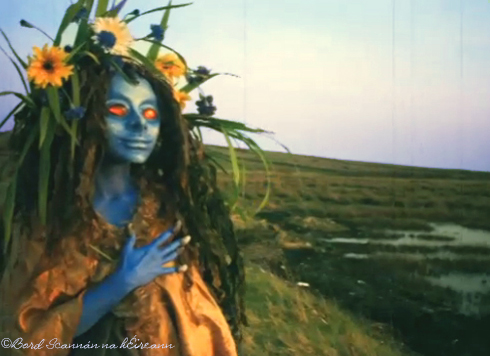
Sheela na Gig and Sacred Space (1)
© Kathryn Price
NicDhàna ![]()
Trickster Hag, laughing and
howling;
Then veiled in the mist, silent as stone.
Gateway and
gatekeeper,
Guide and challenger,
Liminal-dwelling paradoxical crone.
You stand upon a cliff, high above the sea, in a misty grove of silver birch trees. The waves crash and scatter on the rocks below, an eternal sigh of white noise rising. The grey mist swirls around you, cutting off familiar sights and sounds. Nothing is as it was. Nothing is as it seems.
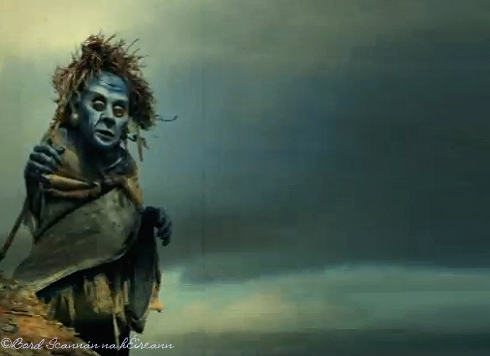
Up ahead and above you in the mist, above the hole in the stone, The Hag of Birth and Death gazes down upon you. Welcoming and challenging, silently waiting, She opens the door to rebirth.
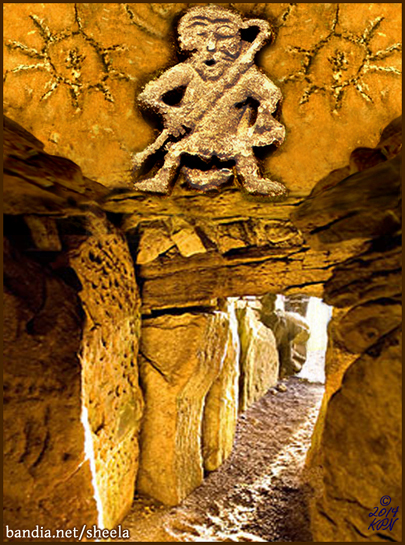
In the shifting realm between the worlds, She reveals to you the gateway the vulva of Woman through which every one of us entered this world,(2) through which all of our foremothers entered this world. Each one emerging from the one before her, all down the line, open archway after archway, reaching back through time, like a vaulted corridor leading directly back to First Woman.(2a)
Wise guardian, Who knows these roads so well, Who has trod these paths for countless generations. Oldest ancestor, Who gave birth to us all, Whose blood runs through our veins. Her cryptic smile hints at secret knowledge She can look every challenge in the face without flinching; She can meet all changes head-on and laugh. In your mind you hear Her whisper Her name: Síla (SHEE-luh).
You bend low and touch the earth, offering a prayer for guidance as you approach this threshold. Out of the corners of your eyes you sense the mist swirling; spiral patterns form and dissolve around you, hinting at mysteries, sparking a distant memory, somewhere beyond your conscious grasp.
You suddenly notice a heron, Síle na bPortach
(SHEE-luh nah BURT-uckh), keeping still, silent vigil nearby. How
long has she been there, watching you? ... You acknowledge her, and her role as
guardian of the gate. You open yourself to her, and you can feel her looking
into you, judging you, deciding whether or not she will let you in. You open
without fear (or despite fear) and join with her stillness. You feel the
silvery-white energy of the birch trees entering you. You breathe in their
purifying, focusing, clean and clearing energy... Opening your heart and
stilling your mind. You chant their ancient name, Beithe (BAY-huh).
You feel the powers of land, sky, and sea come together and focus within you.
You take a deep breath, and climb through.
![]()
You had the
calling and died wonderingwho is it that calls.
We were all
calling. Down from the centuries beseeching you
to release from stone
unparalleled beauty and in doing so
chipping away the stone encasing
hearts.
you were called
you remembered us the
future
We were calling you and I am calling you now.
(3)
It started with the birch tree
My personal altar (in a household full of altars) faces a window, looking out over the trees and the lake. There is a birch tree, one of many, who lives right on the other side of the glass, her boughs sweeping into my line of sight whenever Im at my altar. Sometimes when Im sitting there, Ill open my eyes to see chickadees or catbirds fluttering in her leaves, or through her branches Ill see herons wading in the shallows, or otters splashing and playing out where the waters run deep. The crows and other wildlife come and go, adding their own emphases and omens to my rituals. And with the curtains open, as they always are, the rays of the sun, moon and stars light my work.
On this misty, grey day I was on the other side of the window outside on the rocky slope, meditating with this familiar tree. I was asking her about symbols: What symbol, or Goddess, or animal, works best with the energy of Birch? I had made my offerings of menstrual blood and breast milk, and I sat waiting, opening, huddled in my cloak in the shade on this cold morning in early spring.
Suddenly, I received a very strong and clear image of a
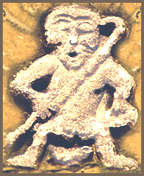
Sheela na Gig -type figure. She was sitting in a grove of birch trees, with her
knees drawn up, displaying her signature wide-open vulva, and a huge, almost
maniacal grin on her face. She was laughing.
I have to confess, I was startled. Im a bit
ashamed to admit it, but the Sheela images had always freaked me out a bit.
Much to my relief, this discomfort was eventually worn away, thanks to
Síla Herself, and also because I cant stand feeling inhibited or
uptight about
well, about much of anything, really. And I certainly
wasnt going to tolerate feeling squeamish about something related to a
vision or a Goddess image. I mean, I was the one who had started this
dialogue
I had asked for the information, and now it was my job to figure
out what to do with it. I figured Id better start working with this
Sheela who had popped into my life. After all, I didnt want to be
rude.
Just who is this mysterious figure, the Sheela na Gig? Is she a representation of the Cailleach the Hag of Winter, the Old Woman who lives in the stones? Is she a Goddess at all, or rather some lesser form of Otherworldly Being? Or were these images merely intended to be grotesques carved on medieval churches to shame women about their bodies, their sexuality, and their power to bring forth life?
When I began looking into her origins, I encountered this range of questions and opinions among various Pagans and scholars. At that time, little research had been done on these images, and even less on the individual being or beings whom they were intended to represent. (4)
For the moment, I decided not to worry about these conflicting theories. I felt a deep need to still the mental voices of the opinions of others and approach her one-to-one, on a spiritual level. As an experiment, I decided to give Her the respect due a Goddess, whether She was one or not. I decided to open to Her in the way I would approach a Deity, revered Ancestor or Nature Spirit, and see what She had to say about it, what She had to show me.
Over the next five years, I experimented with Her (and it seems She experimented with me as well). I did lots of dreamwork and other types of visionary work;(4a) I involved Her in rituals and meditations, to see if She brought through power, and if so, what kind. As I got a clearer understanding of Her, I became more open to seeing when She was appropriate to invite into more formal rituals which I learned largely from noticing when She would simply show up on Her own.
She gradually moved into my household. She now lives
over our Ancestor altar and our Trickster altar. Surrounded by heron feathers,
cowrie shells, leaves of sage from our garden, and a small forest of twigs from
the silver birch who guards our ritual site, She now dwells on the window ledge
over my personal altar framed by the moving, growing branches of that
same birch tree who seems to have brought us together.
If you hold opposites together
in your mind, you will suspend
your normal thinking process and allow an
intelligence beyond rational
thought to create a new form. (5)
In much of the Scottish lore the year is ruled alternately by the Hag of Winter and the Maiden Queen of Summer.(6) Yet I see Síla as another, lesser known, third face of this well-known duality: the manifestation of the usually-hidden doorway that emerges when these forces are balanced or in flux. She holds the doorway which opens in the liminal-times: the days of Bealtaine and Samhain, the twilight of sunrise or sunset, and when the mists arise where the land and the sky meet the waters.(7) She is both and neither, an Otherworldly force that refuses to fit into either/or categories.
She appears when opposing energies meet, and She is also found when the energies of the Three Sacred Realms come together. She opens and holds the center of sacred space the doorway which opens when we connect with the powers of Land, Sky and Sea and balance them within ourselves, opening to the Spirit that flows throughout and unites all three.
I feel Her presence in ritual, when we enter that stillness, on the edge between this world and the next. I feel Her when I center, when I still myself and find the quiet place from which the voice of the Goddess can emerge. I feel Her protection, Her guarding of the gateway, when the voices of the Spirits get to be too much and She kindly offers Her protection the calm and stillness in the center of the whirlwind. As the Storm Hags dance around us, She is the crux point around Whom the world spins. She is the silence that enfolds us, the moment as we poise on the edge before diving into a new realm. Her shining white energy washes us clean. She opens our eyes and gives us the strength and courage to begin anew.
She is the cleansing smoke rising, the blank paper waiting, the silence in the singers head from which the music is born.
Dance me through to
the stillness
to the point where the motion begins.
Dance me
through to the silence
to the edge where the world begins. (8)

Old Woman of the Stones: Historical Sheela
In appearance, the Sheela na Gigs probably most resemble the Cailleach our most ancient Celtic Ancestor, the Old Woman, the Winter Hag. Many simplistically refer to her as a fertility figure.(8a) However, her image combines aspects of fertility and infertility: her plump vulva, suggestive of youth and sexuality, is stretched wide-open as if in childbirth, yet she has no breasts. Or, in other images, when she is depicted with breasts they are almost always the drooping, long and flat breasts of a post-menopausal woman. At times her chest is scarred, with skeletal ribs, a fierce grimace, and the bald head of either a newborn or an extremely aged crone. If we take full breasts and bellies to be symbols of nurturance and material abundance, this is not a nurturing figure. She seems a creature of paradox and contradiction representing the primal extremes of birth and death: the edge-times, the dangerous times.
The earliest known Sheela-type images have generally been believed to have been carved in the late eleventh century, on medieval churches in south-western France, and then later in England and Ireland from the twelfth through the sixteenth century. However, these images of Continental Europe, to my eye, do not much resemble the Sheelas of the Insular Celtic lands, aside from being nude females. While the Continental images I've seen are more likely to resemble human women, many of the insular Sheelas tend to have the characteristic flat-topped, large, vaguely triangular head and emphasised eyes of much older Celtic carvings.(8b) The Insular Sheelas are also much more likely to have the wonderfully weird, otherworldly, androgynous quality which I explore in this article.
The prevailing opinion among scholars, at least at the time of the first publication of this article, was that the Sheelas are a Christian invention, and that there was no firm evidence of Sheelas at ancient Pagan sites.(9) However, I believe this theory could have been due to incomplete research; more recently I have become aware of two or three very old figures on standing stones in Ireland. They are very weathered, but I believe they could very well be Sheelas, or at least precursors to the Sheelas. As far as I'm aware, there has been no official dating of these first two carvings, though some researchers believe at least one of them to be pre-Christian. A recent find in summer of 2003 is most definitely pre-Christian, but we're still determining whether it is in fact a Sheela (I think it is). (9a)
Another fascinating find is the wooden Ralaghan Figure: Found in the Ralaghan Bog at the foot of the Taghart Mountain near Shercock in 1908, this figure is of great significance as is it's find site. It has been radio carbon dated to between 1098 BCE / 906 BCE placing its use towards the end of the Bronze Age. The fact that the figure was carved of yew was significant as the yew tree was considered sacred and was believed to have been endowed with regenerative properties. Taghart Mountain was a hilltop festival site of Lunasa. This site was used as a place of worship by the late Bronze Age people, by the Iron Age Celts and into early Medieval times. The Sexuality of the figure is ambiguous. Quartz grains were found in the pubic hole indicating the possible insertion of a phallus - from the info on the museum card. The figure pictured below is a replica of the original, which is on display in the National Museum of Ireland in Dublin. While this figure lacks many of the characteristics of the later, stone Sheelas, I believe it could possibly be an early precursor to those figures. And it makes one wonder what carvings did not survive.
So for now, the question of their date of origin is still open. We may never know for certain, as the oldest-appearing images - on standing stones in graveyards - have also been heavily worn by exposure to the elements, while the ones in churches are more likely to have been protected (if they weren't defaced by human hands, as has happened in all too many cases). Ultimately, the question of whether the Insular Sheelas are of Pagan or Christian origin may be irrelevant, as early Celtic Christianity was not all that different from Celtic Paganism.
When the Sheela images began to become widespread in Irish churches (12th - 16th cent. ce), the Irish people adopted them enthusiastically, and also began carving them on secular buildings such as castles and mills. The term Sheela na Gig is said to have been adopted by folklorists as simply the common Irish Gaelic expression for an immodest woman.(10) The reason for the adoption of Sheelas on secular buildings has been attributed to the Irish seeing them as a protective force, as noted by nineteenth-century researchers who were told by local Irish people that Sheelas were intended to ward off evil.(11) This is reported along with a fascinating claim from a traveler in Ireland in the 1840s that, in order to lift a curse of bad luck, the afflicted should persuade a loose woman to expose herself to him(!).(12) Here we see the vulva as holding the power to bless and protect.
A delicious irony in this
history of the Sheelas is that, even if they were introduced into the Celtic
lands as a Christian attack on women, it seems wise to suggest that the
device of the Sheela
was absorbed there into a native belief in powerful
female protectors. These carvings upon the later medieval buildings of Ireland
may, then, have been a last manifestation of the old tutelary goddesses.
(13)
In Christian times, She survived
Dwelling over church doorways, reminding those with the ability to see that entering sacred space is to enter the womb of the Goddess the cauldron of death and rebirth, where we are taken apart and rebuilt where we find challenge, dissolution; and then rest, renewal and change. Reminding people that She is the gateway we all entered the world through the womb of a woman. We remained here and grew strong, our spirits rooting and becoming one with our bodies, through the protection of a woman: she who in those early days held the life-and-death power of a Goddess over our tiny, fragile forms. No wonder many people find these images intimidating, frightening, or grotesque.
And She is also the devourer, Who takes us back in at the end of this life dismembering us, stripping away the inessentials, until we are pure spirit transforming us and readying us for our next turn on the wheel.
When we approach the doorway to sacred space, or the gateway to life and death, we go with openness and acceptance of the Mystery: No one truly knows what awaits us on the other side. Will the Goddess who greets you be hideous and challenging? Or will She welcome you with love and open arms? Are you sure She will even be there at all? And which of these challenges is truly the hardest for you to face at this point on your souls journey?
I initially assumed that Sheela was a phonetic spelling of the popular Irish name Síle.(14) But the question remains if Sheela (na Gig) was simply the common Irish Gaelic expression for an immodest woman, and even applied to prostitutes, why on earth would people choose the name for their daughters?(15) I have to wonder: could traits which came to be described as immodest have earlier been seen as free, fierce, or bold traits which were once highly valued in Celtic cultures before the advent of Christianity? Could this name have been applied to rebellious, independent women who refused to be limited by patriarchal laws that treat women as property? What were the origins of this name? Why did the Irish start calling these images Sheela?
In tracing Irish words back to their roots, priority is given to the sound of the words, not the spelling. Many sounds in Irish can only be approximated in English; variant spellings in the manuscripts are due to different authors imperfect attempts at capturing the sounds of spoken Irish.(16) The spelling variations which follow are all pronounced basically the same.
Possible meanings to be explored for Sheela/Síle include: to shelter or shield; the seed which is planted and the ground in which it grows; offspring, race or descendants of; raining; an effeminate person; to think, to consider, to have respect for; and, perhaps my favorite possibility: cause or origin.
In Scotland, we find the word sheiling a shelter, and sheal to shelter. Both are derived from the Icelandic root word for shield.(17) These words are a product of the Northern influence on Celtic language and culture. This meaning certainly fits with the protective function of the Sheelas. But while these words were probably in use in Scotland and England by the time the Sheelas appeared, whether they were in use at that time in Ireland is questionable.
P.W. Joyce gives the root Shee as a corruption of the Irish Sidh a fairy or fairy hill.(18) While this is probably too fragmentary to be the sole answer, it is still an interesting, and appropriate, association.
The Old Irish root word Síl, or Siol (both pronounced sheel), seems to be the strongest possibility. It is from this root that we get the rest of the above-cited words that could be related to Sheela/Síle: Síl seed, offspring, race, descendants. Silad act of disseminating, spreading, to make known. Sílaid either the seed, etc., which is sown or the earth, etc., which is sown with it; causes, brings about, produces; generates, multiplies, spreads.(19)
It was while digging through the Early Irish quotations in tiny print under Síl that I found something that really made me sit up and take notice: Metaphorically, Síl (here using the form Sila) has been used to mean cause or origin.(20) I felt a chill of recognition. This resonated so strongly with the intuitive impressions Id been receiving in my work with Her. And ever since that moment Ive found myself thinking of Her as Síla (SHEE-luh), First Woman, Eldest of the Ancestors.(21) This idea of Síla as the origin also harmonized with my sense of Her having strong connections to the Ancestors and to the sea the sea as the origin of all life on this planet.(21a) I have generally continued to use this variation in the name, both to distinguish Her from the more common personal name, Síle, in reference to the manuscript where this spelling was found, and to commemorate that sense of rightness that hit me when I found it. However, many prefer to use the more common spelling, Síle, and I sometimes do as well. In many ways Síle (Hag) may be the more appropritate variation, depending on which meaning one is leaning towards.
In some areas of Ireland, old women have been called Síle.(22) In more contemporary Irish, we also find Síle defined as an effeminate person, sissy(23) or a girlish young man.(24) This brings up an interesting connection to the Hag, as Cailleach the well-known Gaelic word for hag, old woman, or witch is similarly used to refer to effeminate men. In the second definition of Síle, we find the mention of youth. Here we have twice the paradox: youth and age, and now the topic of gender variance. Gender variance is also seen in Sílaid meaning the seed and the ground in which it is planted, (emphasis mine) and in the gynandrous appearance (no breasts, no hair) of most of the Sheelas.
Gender variance is also suggested in Fiona Marrons experience with the Seirkiernan Sheela: when Fiona touched her, she felt two small holes atop this Sheelas head, much like those found on some continental Celtic Cernunnos figures that feature removable horns. Fiona received a strong impression that, for certain ceremonial purposes, the stag kings horns may have been placed upon this Sheelas head.(25) The Ralaghan Figure, with its pelvic hole and possible removable phallus, shows even stronger gynandrous characteristics.
In these situations and others we see a suggestion of Síla being in between the two polar points of gender, or as encompassing both. In many ancient cultures, gender-variant people were seen as embodying particularly powerful magic. They were seen as holding the paradox-energy that lent them special abilities usually the power to cross over into unseen realms and to have particularly strong connections with the Spirits.(26)
In Irish we also find Síle na bPortach (SHEE-luh nah BURT-uckh) the heron.(27) The heron is a liminal-dweller, living in the misty wetlands of marshes and swamps, and at the edges of rivers, lakes and oceans. They are sacred creatures who travel in all three realms: Land, Sea, and Sky. Herons like to nest in tall pine trees, a tree associated with rebirth. Portach means bog. Port means place of refuge, haven, center; fortified place, stronghold.(28)
Herons are often interchangeable with cranes and storks in Celtic mythology, language and iconography. The word Corr, usually translated as crane, has been used interchangeably for these three similar birds.(29) There are many references to cranes in Celtic mythology as female guardians of Underworld sacred sites Cranes were clearly associated with the world of the dead, and with beings who seemed to bridge the worlds of the dead and the living with their insight particularly old women.(30)
In European folklore we find the image of The Stork carrying infants to their birth parents (a tale which has probably survived due to adults discomfort at answering the childrens question, Where do babies come from?). I believe The Stork could be a surviving reference to the magical role of these liminal birds: guides and guardians who carry spirits from the Land of the Dead (in Celtic mythology found on islands in the western sea), carrying them over the waters and into this earth-realm, enabling the spirits to (re-)incarnate.(31)
Gig is much more obscure. Among many writers, the most commonly-repeated, yet still quite questionable, theory is that the name was originally from one of two possible Irish phrases, Sighle na gCíoch(sheela of the breasts) or Síle-ina-Giob (sheela on her hunkers). While the construction Sighle na gCíoch is phonetically somewhat similar to Sheela na Gig, we've also seen that so few of the sheelas actually have breasts. And the few that do... well, their haggish breasts are really not the most, er, prominent of their features. While Síle-ina-Giob better fits the physical appearance of a number of the Sheelas, I just don't see the word ina-giob migrating to the words na gig, in either pronunciation or spelling, during the time period in question. So I have never found either of these speculations to be credible. They both seem to me to have been arrived at by the same type of process I have followed in preparing this article -- an attempt at reconstructing a meaning in retrospect, rather than discovering a phrase that was actually gathered in the field during the time periods in question. (31a)
One theory that is worth consideration is that Gig could be based on the contemporary Irish slang term for vulva or vagina: Gigh (Gee pronounced with a hard G as in the English go). While this is an obvious candidate, more research needs to be done to determine how old this term is, and whether it is of Irish or Celtic origins at all. 31b
Gig could be related to the Gaelic word gìog (geeg), meaning crouch or to sneak a peek at.(32) Sheela is crouching in many of the images, and she is giving people a peek at what is normally private. Or perhaps it came from the Middle English/Old Norse word gigge whirligig or spinning top, from which we get gig to reproduce another of the same sort (hmm, parthenogenesis?) and gig a small boat.(33) Many boats are in the shape of a vulva, and this again brings to mind the function of crossing over crossing over the waters, whether in physical birth, or in the spiritual journey to and from the Otherworld islands of the dead.
Something I believe to also be worth consideration is Nigheag - another name for the Washer at the Ford. Nigheag nan Allt, the washing-nymph of the streams is an otherworldly Hag, often connected with the giving and breaking of geasa, with prophecy and punishment and the granting of wishes. Because of the Ni sound, and the g being lenited, it wouldn't be pronouned the same as na gig. But visually the two are very similar. And as Sile and Nigheag nan Allt both refer to Hags, I think this is a notable connection.(33a)
I had basically finished writing this article, and was putting away my reference books. As I picked up the Gaelic dictionary, it slipped from my hand and literally fell open to: geug (gayg) a branch, a sapling, a young female, a nymph.(34) In Irish, the word is spelled géag and can mean Genealogical branch (of a family tree) or Image of a girl (made for festival).(35) Both words come from the Early Irish word géc a branch, a bough, a respected person.(36) In both Gaelic and Irish, the genitive form is géige (gayg-e).(36a) In entry #385 of the Carmina Gadelica, we have an autumn waulking song with the curious line, But mayest thou sow them and Géige reap them.(36b) Could this also show a connection to the harvest Maiden and Cailleach customs (an image of a young girl, made for festival), with the Hag as the reaper and/or the corn that is being harvested? Or be yet another connection to the Nigheag nan Allt as a death figure?
In Gaelic folklore, Géigean is a wild man or gruagach type figure -- depicted as fierce and hairy, with connections to death revels, and the festival of Samhain.(36c) Some women in childbed, with no knowledge of Sheelas or Gaelic Hag folklore, have perceived a Hag spirit accompanied by a heron, connected with birth and death, who is covered in hair like the wild man figures.(36d) Tapestrys and old drawings depict both male and female wild men. These Gruagach figures are often tricksters in the folklore. In traditional rhymes and tales, the name of this figure varies, and has been recorded as Géige, Géige, Gìgean, Guaigean, Céigean, Cìogan, Cìgean, and Cuaigean. Dwelly gives ceigean as diminutive and unhandsome person.... clumsily formed and of low stature.(36e)
Could the older words for Sheela na Gig have originally meant something like Origin of our Branch of the Family, Origin of the People, Origin of the Tribe, Image of the Hag-Spirit Who is Also the Spring Maiden (literally, Hag of the Maiden), or Wild Hag Trickster Spirit, Who Rules Over Birth and Death''? Or perhaps any number of variations on these concepts? After all, the Gaelic mind has always loved puns and multi-leveled meanings.
Síla of the branches, Origin of
the Tribes
Síla of the nymphs, Origins of Womankind;
Eldest of
the Ancestors, gynandrous crone and fertile youth,
Hag and Maiden and in
between; seed and ground and truth;
Síla of the bloodlines,
Síla of the trees,
Síla nan Géigean
Síla na
Géige
wise with age and the androgyny
of time(37)
the ageless perfect center(38)
Síla is the Otherworldly gate of Mystery, The gateway of All Possibility, but also the power to focus to reach into the sea of possibility(39) and draw something into manifestation in this world of forms (seize the possibility).(40)
My sense is that She controls whether the gate is open or shut, and that, through aligning with Her, She may confer some of this ability and wisdom upon Her allies.
When present in ritual, the sacred space Síla creates gives me the distinct feeling of being between the worlds not yet completely in the Otherworld, and no longer fully in this world, but in a liminal, charged, basically neutral space from which one can then choose a direction or destination. Whereas other Deities usually control the gateways to specific Otherworld realms, Síla seems to specialize in this liminal zone, the doorway, the center and the edge, where one can pause and center oneself before fully crossing over. Or She can help build a protected space in which one can stay and invite Others to enter. Some of this energy and perception, Im sure, is based on the power of Birch, and I must admit, its now hard to separate the two in my mind.
Síla of the Trees
Burning juniper and rosemary, our
prayers rise with the smoke dancing and
spiraling into the sky.
Bathing ourselves in the scented, energy-filled clouds,
opening ourselves
to the cleansing wind blowing in from the sea.
Am goeth i muir
I am a wind on the sea.
In the Irish ogham lore Birch is associated with birth, beginnings, cleansing and purification, and the type of healing that comes from these energies. Cradles were made of birch to keep fragile newborns safe from unfriendly spirits. An early ogham tale also speaks of Birch as a protector: it was used to protect a woman from being abducted into the Otherworld.
Like Síla, Birch is both a guardian and a gateway. In my experience, they work together synergistically. Part of Birchs protection if she grants it to you is that she doesnt so much banish spirits as set limits and create a breathing space of peace and clarity, from which one can then choose where to go or who to let in or keep out. The energy of Birch and Síla, like juniper smoke, will clear away bad vibes and create a clean and sacred space from which to begin your spiritual work.
Birch can also be a helpful ally for those with mediumistic tendencies. Sometimes the presence of the Spirits can become overwhelming. A reliable method of setting respectful limits with the Spirits is essential. Those dealing with this gift/predicament need to create firm structure to keep sane keeping altars for the Spirits and making clear to Them that the altar is where They stay, not in your head. Giving the Spirits a defined place to hang out, and working out a schedule of rituals regular times for you to check in with Them and do your work together are ways to prevent Them from overwhelming you at inappropriate times.(40a) And when you do your mediumistic work, Birch helps to create a safe space within which you can open.
In my experience this protection from spirits function also extends to dealing with alcoholism. Birch and Síla have an energy Ive found helpful to those in recovery, especially to those in the early stages of getting clean and sober. Their white, clean, Obatala-type(41) energy can be very stabilizing to those stepping through the doorway into a new life of sobriety. Ive also considered that Síla and Birch might be helpful in dealing with schizophrenia, but have not been in an appropriate situation to test this theory.
Síla, Sheela, and Sacred Space
In the twilight of dawns light
She stirs the mist
From the Edge and the Center
The energy
shifts
(from the edge and the center)
(the world shifts)
In our Pagan household, with its variety of altars and shrines, I kept meaning to put Síla over the front door as well But it hasnt happened. Ive lately come to realize that its because the whole house is not sacred space, or at least not in the sense that I usually use that term. I see sacred space as having at least two meanings. First, in the more mundane and political sense: The Earth, our bodies, and all the Earths lifeforms are, in one sense or another, sacred. And second, the way many Priestesses use the term: A space that is particularly charged with magical forces and the presence of powerful Spirits, and which perhaps contains entrances to the Spirit Worlds. Earth is always sacred in the first sense; and She also has power spots, which are sacred in the second sense, whether humans ever work with them or not.
So part of what makes sacred space sacred is that it is energetically and spiritually different from other spaces. It may be safer, it may be more dangerous, but it deals with different levels of reality than we access in ordinary consensus reality. Though the sacred and the mundane certainly flow into and inform one another, there has to be some boundary between them. Otherwise, you can lose yourself in the mist, and you can lose your ability to be fully in either realm. This is a hazard many of us deal with, with varying degrees of success and failure. My work with Síla and Birch is one of the more successful ways Ive dealt with this challenge.
Perhaps to my deeper levels, putting Síla over the doorway to our house would be saying that, the entire time I am in this house, I should be in an altered, extremely deepened state, completely focused on communing with the Spirits and Goddesses. Well, Ive tried living that way, and it has serious drawbacks. Basically, you cant live like that and stay in a body for very long. So, at least for now, Síla is staying over the altars. (Were already spaced-out enough around here, thank you.) But to a more grounded person who connects primarily with Her protective aspect as it seems did those who commissioned many of the Sheelas it may be completely appropriate to place her on outside walls and over doorways where Her protection is desired. All doorways are in themselves liminal zones, and perhaps a Sheela over the door can simply acknowledge this.
(Update 9.20.99:) When my work with Síla first began, I connected overwhelmingly with her gateway function and Her role in establishing sacred space. I was working with Her primarily in ritual, in deeply altered states of consciousness. But after working with Her for a number of years now, Ive gotten better at mediating the difference between simply having a Sheela na Gig image present, and actively asking Síla to open the Gateway. Now that I've had some time to integrate and ground the energies She brought into my life, I've become more aware, and appreciative of, her more general and mundane protective powers. So, She not only lives above the altars here, but, lo and behold, a certain Sheela now guards the doorway to our house, as well.
In Conclusion
So Who is Sheela/Síla Goddess, Grotesque, or Otherworldly Power? Well, these things are not always clear-cut in Celtic matters Powers and Beings can flow, shift, change and have agendas of Their own, and Síla is no exception. The Otherworldly Being Ive contacted through my work with Sheela na Gigs and the birch trees, Whom I call Síla, is a trickster and shapeshifter. Shes a primal force, older than human speech. She does not seem to exist in myth or legend as a human-type figure; Shes far too ancient for that; although glimpses of Her can be found in some of the tales of the Cailleach.(42) She usually manifests more as a distinct energy and Presence, Who speaks through shifting energies and granting visions, and rarely if ever speaks in any human language. When this style proves too vague, She tends to send more recent Ancestors, via vivid dreams, to articulate the specifics.
Like the many individual and unique Sheelas found throughout the Celtic lands, the face She reveals to you may vary drastically, depending upon the land where She is invited, your karma and relationship with Her, and upon your relationship with the land and the Otherworld in general.
We have no way of knowing for certain if my conclusions about Síla resemble anything our Ancestors really believed. For our recent Ancestors, it certainly seems that many of the Sheelas were not initially commisioned as figures of veneration, and that any spiritual Powers and Beings that have come to be attached to these images emerged at a later date after they took root in Ireland, and more recently in the more Pagan pockets of the Celtic Diaspora. However, this theory of the Sheelas' origins is far from proven. It is also possible that the earliest Sheelas were created by our long-ago Pagan Ancestors, or that they had images that were so similar to the Sheelas that the two streams of iconography merged. Whichever theory one believes whether it's due to their Pagan, or despite their Christian, origins it seems clear that the images are now Spirit-suffused: that Older Spirits, Goddesses even, have seen fit to influence the artists and come through the Sheelas to attach Themselves to the images and dwell amongst us today.
This is simply one Priestesss account of how Síla has manifested in my personal work and among the ever-widening group of people with whom Ive shared these ideas and rituals. One of my reasons for publishing this article, and now maintaining this website, is to see how others resonate with this information. And, well... She was getting on my back about putting it out there.
All praises to Síla of the Paradox:
The boundary, the border,
the edge
and the center;
The sunset and sunrise,
She of the sly grin, She of the
wide eyes;
Grimacing crone, Life-giving hag,
the heron, the crane, and
the stork with her bag.
Spinning and laughing, Paradoxical Crone,
Opener of the Way, Old Woman of the Stones.
Dancing in dawns light
Capering in twilight
Sharply awakening
The Hag of the Stones
Sends rays of light piercing
Clarity burning
Deep in your heart
Deep into your bones
![]()
| Kathryn Price
NicDhàna (Formerly Kathryn Theatana) is living by the Boann Brook in the Northeastern Forest, hanging out with the Spirits, listening to the trees, and writing it all down. She can be reached at www.bandia.net The original version of this article appeared as Síla of the Trees in the Sacred Spaces, Sacred Places issue of Sagewoman Magazine (Winter '98/'99). It has been substantially revised and expanded for the web. This article is copyright ©1998, 2006 and may not be reprinted without the express, written permission of the author. Last revision: ThornBlossom Moon, 2006 |
![]()
Footnotes:
(1) Language Note: The phonetic spelling Sheela indicates the Sheela na Gig images. The Early Irish spelling Síla indicates the Otherworldly Being or Goddess Whom I believe the images may represent. Both are pronounced the same. Lower-case pronouns (she, her) refer to the images. Capitalized pronouns (She, Her) refer to the Goddess(es). All pronunciations are approximate the Celtic languages contain sounds not found in English, and pronunciation varies regionally. (back)
(2) For those born by C-Section - who exited their mother's body through the belly, not the vulva - this may be merely symbolic. Yet note how wide-open the passageway is, and how it goes all the way up into her belly - even the largest of newborns could fit through that gate. (back)
(2a) A fabulous new find: The Woman Sculpture Site has a cool sculpture illustrating this concept. (back)
(3) Patti Smith, Early Work (New York: W.W. Norton, 1994), p. 169. (back)
(4) Notable recent exceptions in the US: Lori DeMarre,
Sheela na Gig (Interview with Irish Artist Fiona Marron), The Beltane
Papers Issn 4 (Samhain, 1993), pp. 4-11. Ronald Hutton, The Pagan
Religions of the Ancient British Isles (Oxford, U.K. and Cambridge U.S.:
Blackwell, 1995), pp. 308, 310-15.
¶ (Update, 2/4/00): A caveat
about Hutton - While he was one of the only scholarly sources
available in the US when I began this article, I've since realized how
incomplete some of his research is. While his books are generally excellent
studies of history in relation to Neopaganism, his research on Sheelas is
superficial at best. He has neglected to mention the Sheelas that contradict
his theories. Whether this is due to incomplete research or other factors, I
cannot say. However, I apologize for my former high reccomendation of this
book. I still think it's worth reading, although it should be approached with
the same amount of critical thought with which one approaches the feminist
scholars of whom Hutton is so critical.
¶ On a much more positive
note, thanks to the internet, many scholars are now in touch with one another
and great progress is being made in investigating the Sheelas - they are no
longer being totally neglected. See our
Sheela Links
section for some of these fabulous resources. (back)
(4a) Traditional Gaelic and Celtic Reconstructionist Pagan (CR) methods of seeking vision include making offerings to the spirits,Echtra, Aisling, Immram, and other techniques of Filidecht. I am in no way referring to Harner core shamanism or other commercial co-optations of First Nations practices. This page reflects my view on modern shamanism, and has links to some other excellent sites, such as this one and this one. (back)
(5) Niels Bohr, physicist, quoted in The Art of Genius, The Utne Reader Issn 8750-0256 (August 1998), p 76. (back)
(6) The Maiden/Queen is also known as the Spring Maiden - sometimes seen as a face of the Goddess Brighid. The Celtic year is divided into halves - Winter: Samhuinn to Bealltainn (ruled by the Hag); and Summer: Bealltainn to Samhuinn (ruled by the Spring Maiden/Summer Queen). Samhuinn and Bealltainn are the Scottish Gaelic names for Halloween and May Day. (back)
(7) Erynn Rowan Laurie introduced me to the concept of the double spiral gateway and the possible third point within, in 1993. Though our Deity correspondences differ, and our work has gone in different directions since then, I believe she or Gordon Cooper were the first to introduce discussion of the double spiral gateway into the Celtic-related discussions taking place at that time.(back)
(8) From dance me through, darkmoon song cycle ©1989 kpt/katharsis ink. (back)
(8a) Fertility Figure usually being archaeological and anthropological shorthand for we have no idea. Often applied dismissively to any female figurine about which insufficient research has been done. Or, to paraphrase Judy Grahn, 'Fertility [Figure]' is one of those generalized terms used to vaguely describe what is imprecisely understood. (back)
(8b) Almost any well-illustrated Celtic Art book with Celtic stonecarvings will illustrate this point, but here are a few references I've compiled in the Illustration Notes. (back)
(9) The exception being the Pagan sacred sites where churches were later built and the Sheelas carved over their doorways. However, many who have observed the Sheelas in situ have noted that some appear to be much older, more worn, and sometimes of different stone than the surrounding structures on which they are mounted. Some believe this could indicate that the carvings of the Sheelas existed before the churches were built. (back)
(9a) For two Irish Sheelas on standing stones, see
Stepaside Sheela, Co. Dublin and
Tara Hill Sheela-na-gig, Co. Meath. Photographs and
commentary by Tara McLoughlin, on her fabulous
Tara's Sheela-na-gig Website.
¶ In the summer of
2003, a new figure was found that may predate all of these:
Historic stone carving uncovered in Co Fermanagh. To those
of us looking at the photos, this carved stone image, originally from a
graveyard on nearby Lusty More Island, [which] has possible links to the
renowned Janus figure at Caldragh Cemetery on Boa Island sure looks like
a possible in situ Sheela to us. We're awaiting word back from our trusty
sheela-scouts, but this figure, estimated to be around 2,000 to 3,000 years
old, could be an extremely important find. These two-faced Janus
figures' possible connection to the gatekeeper function also seems very
significant. She also looks like she has coins at her feet - are people making
offerings?
¶ I'm not sure why they're calling this one a
new find, since there's a picture of it on plate 22 of John
Sharkey's Celtic Mysteries - The ancient religion(New York: Thames and
Hudson, 1975)(back)
(10) Hutton (1995), p.311. Australian slang usage seems to also support this meaning: as their white population began as a British prison colony, perhaps the word was imported with Irish prisoners. (back)
(14) Alternate spellings of Síle include Sheila, Sheela and Sheelagh. Síle is also used to translate Julia and Cecilia. (back)
(15) Perhaps to honor St. Cecilia, patron of music, or St. Julian, patron of travellers and boaters? Actually, the quote, simply the common Irish Gaelic expression for an immodest woman comes from Hutton (1995), p. 311. As we've had so much trouble finding any Irish Gaelic meaning for Sheela na Gig, let alone a common one, I have to question Hutton's research here. Sadly, I wouldn't be surprised to hear he has no Gaelic. (back)
(16) P.W. Joyce, Irish Place Names in Ronan Coghlan, Ida Grehan, & P.W. Joyce, The Book of Irish Names (New York: Sterling Publishing, 1989), p.85. (back)
(17) Websters Unabridged Dictionary, 2 vols. (U.S.: William Collins & World Publishing, 1975), pp.1671, 1669. (back)
(18) P.W. Joyce (1989), p.114. (back)
(19) The Royal Irish Academy, Dictionary of the Irish Language (Antrim, N.Ireland: Greystone Press, 1990), pp.542-3. Malcolm MacLennan, A Pronouncing and Etymological Dictionary of the Gaelic Language (Edinburgh: Acair/Aberdeen University Press, 1991), pp. 299-301. Niall Ó Dónaill, Foclóir Gaeilge-Béarla (Éireann: Mount Salus Press, 1992), p.1092. (back)
(20) The Royal Irish Academy (1990), pp.542-3. (back)
(21) When I speak of Síla as the Eldest of the Ancestors, Im invoking the elder indigenous spirits of the Celtic lands. However, our actual human Ancestors originated in Mother Africa. So, as part of Sílas shifting, paradoxical nature, I personally see Her also as a representative of our eldest African Ancestor - or, at the very least, strongly connected to this most ancient of our foremothers. (back)
(21a) I later came across the The Rochester Sheela na Gig, who holds a fish in each hand and strongly resembles the Celtic double-tailed mermaids found on standing stones and manuscripts. The Kildare Sheela is in a similar posture, as is The Glendalough Sheela and the merperson from the Meigle, Perthshire standing stone in George Bain's Celtic Art (New York: Dover, 1973) p.120, plate V. An image I've seen, said to be of the Norse Goddess Freya, is also very similar, but I don't know the background or veractiy of this design (had a link but the page is gone now).(back)
(22) DeMarre (1993), used to describe old women in County Cork. (back)
(23) Ó Dónaill (1992), p.1092. (back)
(24) Tomás De Bhaldraithe, English-Irish Dictionary (Éireann: Criterion Press, 1992), p. 297. See also Who is Sheila? by Dymphna Lonergan on use of the word to describe effeminate men in both Ireland and Australia.(back)
(25) DeMarre (1993). Seirkiernan Sheela, County Offaly, Ireland, 13th-16th cent. C.E. (back)
(26) Judy Grahn, Another Mother Tongue (Boston: Beacon Press, 1990). Randy Connor, Blossom of Bone (New York: HarperCollins, 1993). (back)
(27) ODonail (1992), p.1092. (back)
(29) De Bhaldraithe (1992), pp. 336, 157, 711. MacLennan (1991), p. 101. (back)
(30) Alexei Kondratiev, More on Saint Patricks Snakes and Other Irish Critters, Our Pagan Times Vol. 4, No. 4 (April, 1994), p. 19. See also: Katharine Briggs, An Encyclopedia of Fairies (New York: Pantheon Books, 1976), pp. 57-60, on the Cailleach as a guardian of animals and wells, and how on the Isle of Man, where She is known as Caillagh ny Groamagh, or the Old Woman of Gloominess....She is said to have been seen on St. Bride's day in the form of a gigantic bird [emphasis mine], carrying sticks in her beak.(back)
(31) The species of marsh-bird fulfilling this role seems to vary regionally, depending on which is found on the land in question. (So, does this mean that in tropical realms Sílas totem is the Pink Flamingo(!)?) (back)
(31a) It is unclear where these two theories originated. It is likely they were first published by Dr Jørgen Andersen in his 1977 publication, The Witch on the Wall: Medieval Erotic Sculpture in the British Isles. Eamonn P. Kelly also mentions them in his 1996 publication, Sheela-na-Gigs: Origins and Functions. (back)
(31b) For more on this see Gay Cannon's fabulous site: Ireland's Síle na Gigs. There was also a discussion on the problems with the theory on Old-Irish-L.(back)
(32) MacLennan (1991), p.180. (back)
(33) Websters Unabridged Dictionary (1975), p. 770. (back)
(33a) Alexander Carmichael, Carmina Gadelica, (Hudson, New York: Lindisfarne Press, 1992), p526. Text notes to entry #536.(back)
(34) MacLennan (1991), p. 179. (back)
(35) ODonail (1992), pp. 616-17. (back)
(36) The Royal Irish Academy (1990), p. 357. (back)
(36a) The genitive form is the possessive. So, for example, when coupled with na or nan, it means Síla of the branches or Origin of the Tribes instead of just Síla branches or Origin Tribes. In the pronunciation of géige - gayg-e or gayk-e the final e should really be a schwa (but I couldn't figure out how to make one in any of the available fonts). And depending on dialect, the final e may or may not be voiced. Na Géige is the genitive singular. The plural is more commonly written nan Geug, but with a bit of poetic license it could also be written nan Géigean - it's a pun on an obscure word from Cormac's glossary: gigean , geigean - master at death revels (Carm.) found also in McBain's online dictionary. With Síla's doorway between the world of the living and the world of the dead connections, I particularly like this pun, even if most people won't get it. Gigean, a dwarf; said too of a naked child. (MacLennan, p. 180) - The sheelas don't really resemble children, but they are small and naked. (back)
(36b) Carmichael (1992), p526. Entry #385, Verses
made at the waulking frame: Thou girl over there, may the sun be
against thee! / Thou hast taken from me my autumn carrot, / My Michaelmas
carrot from my pillow, / My procreant buck from among the goats. // But if thou
hast, it was not without help, / But with the black cunning of the dun women; /
Thou art the little she-goat that lifted the bleaching, / I am the little
gentle cow that gave no milking. // Stone in shoe be thy bed for thee, / Husk
in tooth be thy sleep for thee, / Prickle in eye be thy life for thee, /
Restless watching by night and by day. // May no little slumberer be seen on
thy pillow, / May no eyes be seen upon thy shoulder, / But mayest thou sow them
and Géige reap them, / And Morc garner them to the green
barns!
¶ For a wealth of info on the Michaelmas and other harvest
traditions, including info on the Cailleach and those grain and carrot rituals,
see: F. Marian McNeill, The Silver Bough - Vol. Two - A Calendar of Scottish
National Festivals - Candlemas to Harvest Home(Glasgow: William MacLellan,
1959).(back)
(36c) Ronald Black (ed), John Gregorson Campbell's Superstitions of the Highlands and Islands of Scotland and Witchcraft and Second Sight in the Highlands and Islands (Edinburgh: Birlinn, 2005), p.457. (back)
(36d) Private correspondence and conversations with author. (back)
(36e)Black (2005), p. 457. (back)
(37) Sheri S. Tepper, Gibbons Decline and Fall (New York: Bantam, 1997), p. 452. (back)
(38) Smith (1994), p. 155. (back)
(39) Patti Smith, Land, Horses (New York: Arista Records, 1975). I hold the key to the sea / of possibilities...(back)
(40a) Modupue (many thanks) to Teish for teaching me this survival skill. (back)
(41) Orisha Obatala is the Yoruba (African) androgynous Creator Deity of the sky, the white cloth, and the elderly. His/Her children do not drink alcohol. (back)
(42) For some tales of The Cailleach, and even sound
files with pronunciations, Cailleach Bheur: In Highland and Lowland by
Fuillann nam Socair, was a great resource, but the site is now down. Let me
know if it reappears. (back)

back to
articles
webrings |
lots more pagan stuff |
banners and general links
sign
guestbook |
view
guestbook
copyright ©1998, 2007, Kathryn Price NicDhàna,
all rights reserved.
Not to be reproduced, except for brief quotations for
review purposes, without the written permission of the author.
All artwork
is copyright the individual artists, not to be reproduced without the written
permission of the artists.
Text partially revised 5.20.06
Original
version appeared in the Winter '98/'99 issue of
Sagewoman Magazine
webcrafter at bandia dot net (manually correct address to
foil spambots)
Kathryn
NicDhàna Kathryn Price NicDhàna KPT NicDhàna Kathryn
NicDhana Kathryn Price NicDhana Sheela na Gig Sila na Gig Síla na Gig
Síla na Géige Sila na Geige Sile na Geige Síle na
Géige Sheila na Gig Sheelagh na Gig Shiela na Gig Sile na Gig
Síle na Gig Síle na Gigh Shile na Gig Sheela-na-Gig Sheelah na
Gig Shila na Gig Celtic History Celtic Art History Ecofeminist Feminist Women's
Spirituality Celtic Goddess Images Pàganachd Bandia Pàganachd nam
Bandia Pàganachd Bhandia Paganach Paganachd Bandia Nigheanan nan
Cailleachan Goddess Herstory Celtic Goddesses Celtic Goddess Myths Celtic
Goddess Tales Celtic Goddess Research on Celtic Goddesses Research on Celtic
Art Spirits Celtic Spirituality Celtic Reconstructionist Paganism Celtic
Reconstructionalist Paganism Celtic Reconstructionists Celtic Reconstructionist
Goddesses Celtic Reconstructionist Goddess CR Goddess CR Goddesses Celtic
Goddess Worship Celt Celts Celtic Pagans Celtic Paganism Keltic Pagan The
Cailleach The Cailleachan An Cailleach An Cailleachan An Chailleachan the storm
hags the wind hags birth goddesses death goddesses herons cranes storks Queer
Spirituality Kathryn Theatana Kathryn Price Theatana kpt katharsis ink
Caitriona NicDhana Caitríona NicDhàna art-ré nemed art-re
nemed neamedh nemeadh Priestess Priestesses Priestessing the death crones Druid
Druids Druidry Bard Fili Filidh Filidecht Celtic Ritual Poets Seers Visionary
Visionaries Celtic Ritualists Celtic Psychics Psychic Research Moonstone Circle
Dianic Dianics NeoPagan NeoPagans Tribal Tribe Tribes Bandia Nigheanan na
Cailleachan flaming crones Poetry Articles Essays Brighid Danu Invocations
Ancestors