This is now the News page. I've added
a new Index that includes a brief overview of what all
is on this site (sort of the tl;dr version of the long article, with some new
info), along with section links to particular parts of the article. I have a
new Day of the Hag photo montage, and we will
soon be releasing our lovely
Latha na Caillich
video on our new
Gaol Naofa
YouTube Channel.
Most of the changes are live now, but
bear with me while I update links and tweak the formatting. This site was
initially created in the very early days of the web. So there's a lot to
update.
I just got a copy of a book that
relies heavily on the work I published in 1998... without any credit,
footnoting or mention. Oh. More to come on this... Sadly, it's not the first
time this has happened to those of us who are researching in obscure areas.
We've actually had to start anti-plagiarism groups for just this sort of thing.
News Alert, Spring,
2013
At some point I will be integrating
these findings into the main article but, for now, check out what my dear
friend and colleague, Annie, turned up:
Sheelah's Day. Finally. Confirmation for why that
dictionary fell open to that page years ago and led me to investigate the
etymology of géag. While another writer who has more recently
published certainly looks to have gotten the idea from me (I first published
the theory in 1998, and no one else mentioned it until well after my work was
on the web), the other sources on this are over 100 years old. Yet Annie and I
first heard of them last month. Sheelah's Day was not celebrated, or spoken of,
where I grew up in the diaspora (Chicago and Boston), nor in Scotland that we
know of. I've also asked among my contemporaries in various parts of Ireland,
both Catholic, Protestant and polytheist, and none of them have heard of this
either. So it looks like it was not a widely-known celebration and, like the
Sheelas, we really can't be certain how old it is. But since it's clearly a
local variation on the tales of the Cailleach, and the Cailleachan, as beings
who control the weather, I think the connection is clear.
Major Update, SamhainTide,
2012
It's been six years since my last
update, and fourteen years since the first version of this article was
published. In working with Síla daily (as she who opens the way to the
spirit world), some of my conclusions have morphed a bit over the past twenty
years. I now see her as most definitely a name of, and depiction of, the
Cailleach as Creator. I came to this conclusion years ago, and had suspected it
at the initial writing, but had not updated the article to state this more
clearly. I believe that Síla is a depiction of the Hag in the act of
creation. My theory is that the sheela figures depict the power of a woman to
give birth to a child, and our oldest female ancestor who gave birth to
many tribes of humans, and a Spirit Woman who creates features of the
landscape (mountains, rivers, and perhaps the world itself). Check out the
Cailleach tag on my blog, and the
Gaol Naofa
FAQ for more on her role as a Creator.
News from the front, ThornBlossom
Moon, 2006
I have updated the
etymology sections a bit, including some
more Gaelic folklore on Géige as a Gruagach-type
figure.
Just added a few new links to the
main article and the Links section.
Moon of the Big Green Leaves,
2004
Updated with
Gay
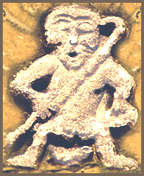
Cannon's photo of the Bronze Age proto-Sheela, and Shae Clancy's photo of
the Boa Island figure (where you can see that people have been leaving her
offerings). A few more etymological explorations, some footnotes on material
found in waulking songs and Scottish harvest rituals, and a couple more things
on Sheela and gynandry/gender-variance.
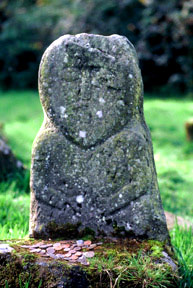
In the summer of 2003, a "new"
figure was found that may predate the more well-know Sheelas:
Historic stone carving uncovered in Co Fermanagh. To those
of us looking at the photos, this "carved stone image, originally from a
graveyard on nearby Lusty More Island, [which] has possible links to the
renowned Janus figure at Caldragh Cemetery on Boa Island [in the Fermanagh
lakeland, between Kesh and Belleek]" sure looks like a possible in situ Sheela
to us. According to local historian John Cunningham, "the two are
pre-Christian, dating back around 2,000 to 3,000 years." We're awaiting word
back from our trusty Sheela-scouts, but this could be a really significant
find. These two-faced "Janus" figures' possible connection to the gatekeeper
function also seems very significant. She also looks like she has coins at her
feet - are people making offerings?
I'm not sure why they're
calling this one a "new" find, though, since a picture of it can already be
found on plate 22 of John Sharkey's Celtic Mysteries - The ancient
religion (New York: Thames and Hudson, 1975), as well as in a few other
books on Celtic art and landscape. Guess it was just new to that newspaper
;-) Photo above left courtesy of Shae Clancy.
I've done some major revisions to Síla na Géige - Sheela na Gig and Sacred
Space. The text is only changed in a few places, but I have
substantially changed my views on some of the historical theories concerning
the Sheelas. I have also added a couple more photos (real, historical Sheelas
on standing stones!) and updated some links.
One of the fabulous things about the Internet, and
this website, is that I'm now in touch with Sheela scholars from all over the
world -- a gift I did not have when I wrote the original version of the
article. Consequently, I'm now revising some of my theories. This is common in
historical research, and readers may be glad to know that I am now questioning
the possible biases of Ronald Hutton, who was a major source for my initial
research. I now feel that Hutton has neglected key evidence. Whether this
neglect is due to lack of awareness -- he, too, was dealing with a
largely-unresearched area in writing about the Sheelas -- or due to the alleged
anti-Pagan and anti-Woman agenda of which many feminist scholars have accused
him, I cannot say. The problem may simply be that he tried to cover too much
material at once, and so only skimmed the surface in some areas.
What I will say about all of us doing research in
this area, is that up until very recently very little was written about the
Sheelas, and almost none of it from a scholarly viewpoint. In the US you could
find almost nothing on them. And what little material was available was often
heavily biased towards romantic fantasies. So perhaps, in an effort to bring
some balance to the debate, there was a tendency, on my part, and Hutton's, to
swing too far to the contradictory and more conservative of archaeological
theories.
But now things are different. We e-mail and
e-publish our data, we share our experiences, images and theories. Research has
speeded up to an astonishing degree. For those of us willing to be flexible and
open-minded, to have courage, humility, compassion and the ability to ride the
waves of change, it is truly an exciting time.
Some pages from the Moonstone site
are still archived on this server, but most of our work has shifted to
individual writing projects as well as our work with CAORANN and Gaol
Naofa.
Check out our Gaol Naofa FAQ, which
is more recent than the CR FAQ, and goes into much more detail about
Gaelic
Polytheism as preserved and practiced by the members of our
community.
Kathryn can usually be found at her
blog:
And for the best, consensus
introduction to, and definition of, Celtic Reconstructionism:









![the death crones. pagan satire. welcome the darkness... [copyright ©1987,1998 flaming crones. All rights reserved.]](images/CroneBanner.gif)